

"Different countries, different customs," as the saying goes. But different countries also mean different electrical outlets. This article aims to provide a brief overview of the different types of electrical outlets. After all, there are over a dozen different types, and it can sometimes be difficult to keep track.
The different types of sockets
The image below shows the most common types of electrical outlets. Types C and F are the most familiar in Germany. The others are only familiar from vacations or business trips. Type K, in my opinion, looks like a very friendly smiley face.
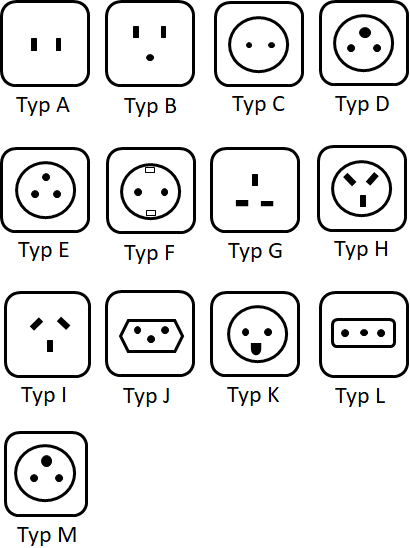
The table gives a rough idea of where the different types can be found.
| type | Countries |
| A+B | Antigua, Bahamas, Barbados, Belize, Bermuda, Brazil, China, Costa Rica, Ecuador, Guatemala, Honduras, Jamaica, Japan, Canada, Colombia, Libya, Mexico, Panama, Peru, Puerto Rico, Saudi Arabia, Tahiti, Thailand, USA, Venezuela |
| C | Afghanistan, Albania, Algeria, Angola, Argentina, Armenia, Bolivia, Brazil, Bulgaria, Cambodia, Canary Islands, Chile, Denmark, Egypt, Finland, Gabon, Germany, Greece, Hungary, Iceland, India, Indonesia, Iran, Iraq, Israel, Italy, Macedonia, Madagascar, Mongolia, Morocco, Mozambique, Nepal, Netherlands, Norway, Pakistan, Peru, Poland, Portugal, Russia, Sweden, Serbia, Somalia, Spain, Sudan, South Korea, Syria, Thailand, Tunisia, Turkey, Ukraine, Zambia |
| D | Ethiopia, Ghana, Greece, India, Iraq, Kuwait, Nepal, Nigeria, Pakistan, Zambia, Zimbabwe, Sudan |
| E | Belgium, Benin, France, Greece, Cambodia, Canary Islands, Madagascar, Mongolia, Morocco, Poland, Slovakia, Syria, Tahiti, Czech Republic, Tunisia |
| F | Afghanistan, Albania, Algeria, Bulgaria, Croatia, Finland, Germany, Greece, Hungary, Iceland, Indonesia, Italy, Macedonia, Mozambique, Netherlands, Norway, Austria, Portugal, Russia, Saudi Arabia, South Korea, Spain, Sweden, Turkey |
| G | Bahrain, China, Ghana, Great Britain, Guatemala, Hong Kong, Indonesia, Iraq, Ireland, Channel Islands, Kenya, Kuwait, Malawi, Malaysia, Malta, Nigeria, Saudi Arabia, Seychelles, Singapore, St. Lucia, Uganda, Zambia, Zimbabwe, Cyprus |
| H | Gaza, Israel |
| I | Argentina, Australia, China, Fiji, Guatemala, New Zealand, Samoa |
| J | Ethiopia, Switzerland |
| K | Denmark |
| L | Ethiopia, Chile, Italy, Canary Islands, Syria |
| M | Botswana, Hong Kong, Mozambique, Namibia, South Africa |
If you're developing a system with a mains connection, you should specify in which countries the system will be sold and operated. When creating the country list, you should pay attention to the respective socket types, the mains voltage, the mains frequency, and country-specific characteristics, such as significant mains frequency fluctuations and voltage drops. All in all, it's not a complex topic, but one that shouldn't be overlooked. With a standardized checklist, the topic is quickly resolved, allowing you to focus on other things, such as which adapters you'll need for your next vacation :-)
Best regards
Goran Madzar