IEC TS 60601-4-2 explains: Functional performance characteristics and EMC requirements for medical devices

Martin Bosch

13/08/2026

Traditionally, EMC testing of medical devices focuses on Basic safety and essential performance characteristics. But what happens to functions that are not directly safety-critical, but nevertheless play an important role in clinical application?

This is precisely where the IEC TS 60601-4-2 on. While most manufacturers meet the basic requirements of IEC 60601-1 and the EMC collateral standard IEC 60601-1-2 While some documents from the same family of standards are well-known, others are often less familiar.

In addition to international standards, the IEC also publishes Technical Specifications (TS) and Technical Reports (TR). These documents contain additional guidelines and recommendations for the application of existing standards. The IEC published the Technical Report back in 2016. IEC TR 60601-4-2. In 2024, this was changed by the Technical Specification IEC TS 60601-4-2 replaced.

What is IEC TS 60601-4-2?
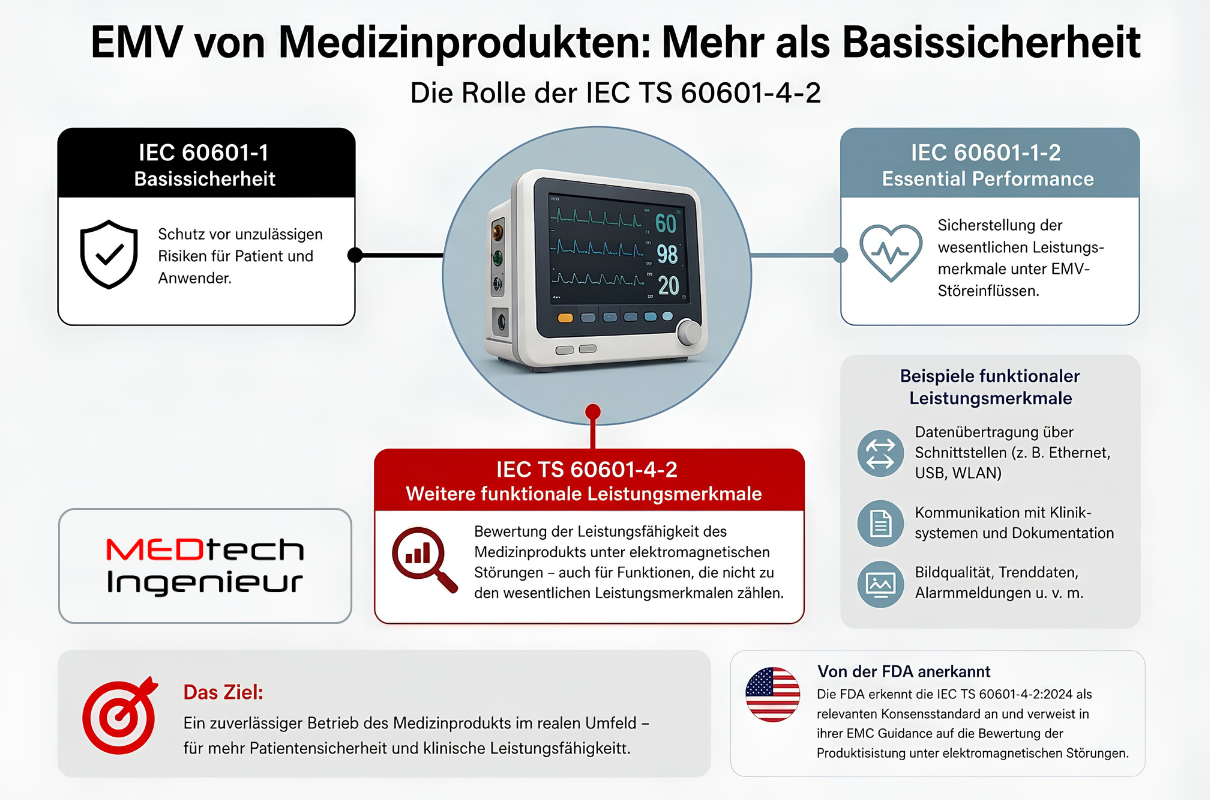
The IEC TS 60601-4-2 supplements the one in IEC 60601-1-2 The described EMC requirements are supplemented by additional guidelines for evaluating product performance under electromagnetic interference.

IEC 60601-1-2 defines requirements for the electromagnetic compatibility of medical devices and considers in particular possible effects on Basic security and essential performance characteristics.

Many medical devices, however, have additional functions that are relevant to their intended purpose, even if their failure does not immediately lead to an unacceptable risk. IEC TS 60601-4-2 helps manufacturers to address such issues. functional performance characteristics to identify and systematically evaluate their behavior under electromagnetic disturbances.

It is important to note that IEC TS 60601-4-2 is not an independent product standard, but a technical specification that provides manufacturers with additional guidance for evaluating and documenting product performance.

IEC TS 60601-4-2 EMV-Anforderungen für Medizinprodukte

Why is considering basic security and essential performance not always sufficient?

The classic EMC assessment of medical devices focuses on the question of whether electromagnetic interference can pose a risk to patients or users. For this purpose, basic safety and essential performance are considered in particular.

In practice, however, many medical devices have functions that go beyond this safety consideration. These functions may not be directly safety-critical, but can be crucial for the intended use.

A ExampleA medical device can store, transmit, or display measurement data. If these functions are affected by electromagnetic interference, there may be no immediate safety risk. However, faulty or lost data can influence further diagnosis or treatment decisions.

IEC TS 60601-4-2 therefore broadens the perspective: Not only safety-critical functions must be considered, but also other functions that are relevant to the intended purpose of the medical device.

The terms can be simplified and distinguished as follows:

Expression

Meaning

Basic security

Protection against unacceptable risks from hazards to the medical device

Essential Performance

Functions whose failure or deterioration could cause an unacceptable risk

Functional performance characteristics

Other functions that are relevant for the intended use

What functional performance characteristics does IEC TS 60601-4-2 consider?

IEC TS 60601-4-2 lists various examples of functions that may be part of the intended purpose of a medical device, but are not necessarily classified as Essential Performance.

These include, for example:

  • the ability of an ultrasound device to print an image via an interface,
  • the ability of a patient scale to accurately measure a patient's weight,
  • the correct transmission or storage of measurement data,
  • The reliable presentation of information for the user.
In the case of ultrasound image output, the medical device has a wired data interface. This interface may be considered during EMC testing, but it does not necessarily represent an essential performance characteristic.

In clinical practice, however, it can be crucial that the transmitted data is correct and complete, as it may form the basis for further diagnostic or therapeutic decisions.

The evaluation of functional performance characteristics should not be carried out in isolation, but rather integrated into the development and risk management process of the medical device. According to ISO 14971 Manufacturers must systematically identify and assess risks and define appropriate risk control measures. This also includes considering the potential impact of electromagnetic interference on product function.

How can manufacturers implement the requirements of IEC TS 60601-4-2?

Before conducting EMC testing, manufacturers should consider the following points:

  1. Identify relevant functions
    All functions of the medical device should be evaluated with regard to their relevance to its intended purpose.
  2. Define performance criteria
    For relevant functions, it should be defined what behavior is acceptable during and after electromagnetic disturbances.
  3. Derive test requirements
    The defined criteria must be integrated into suitable EMC tests so that product performance can be evaluated under interference.
  4. Document results
    The assessment and test results should be transparently incorporated into the technical documentation.
By defining functional performance characteristics early on, manufacturers can reduce uncertainties in EMC testing and prepare regulatory evidence more efficiently.

For approvals in the USA, the evaluation of functional performance characteristics is becoming increasingly important. The FDA recommends the application of IEC 60601-4-2 for evaluating functions related to the intended use of a medical device. Since the test procedures largely correspond to those of IEC 60601-1-2, they can generally be evaluated within the same EMC testing.

Conclusion: IEC TS 60601-4-2 expands the consideration of EMC requirements.

IEC TS 60601-4-2 expands the scope of EMC testing for medical devices. In addition to basic safety and essential performance, it also focuses on other functions that may be relevant for the intended use of a medical device.

For manufacturers, this means that functional performance characteristics should be taken into account during product development and when preparing for EMC tests.

A structured evaluation of these functions not only supports a better EMC strategy, but also creates a solid basis for technical documentation and international approvals.

We support medical device manufacturers in defining suitable performance criteria and preparing for EMC tests according to IEC 60601-1-2 and IEC TS 60601-4-2. Contact us for a free initial consultation.

Further information:


Written by Martin Bosch

Martin Bosch is a dedicated hardware developer who pursues his passion for electronics at MEDtech Ingenieur GmbH. His expertise includes the development of embedded electronics, specifically for medical applications. His focus is on the design of printed circuit boards and circuits that integrate both microcontrollers and analog circuitry. These are used in a wide variety of devices, from blood analyzers to defibrillators.


More articles

  • 05/11/2026
  • General, AI, Regulatory, Requirements Engineering, Software, Systems Engineering, Tools

Can AI radically increase efficiency in medical technology? Formulating requirements, structuring information, clarifying ambiguities: A great deal of work is involved in the development of medical devices before the first technical solution is implemented. ...

Read more
  • 22/10/2026
  • General, Hardware, Mechanics, Quality, Testing

A prototype works. The device starts up, the electronics function as intended, and the first test is successful. However, this does not mean the development is complete by any means. Because with a ...

Read more
  • 08/10/2026
  • General, Documentation, Medioora, Requirements Engineering, Software, Systems Engineering

When requirements start to spread... The larger and more complex a medical device development project becomes, the more information is generated. Requirements are documented, technical decisions are made by others. ...

Read more
Privacy Overview

This website uses cookies so that we can provide you with the best user experience possible. Cookie information is stored in your browser and performs functions such as recognising you when you return to our website and helping our team to understand which sections of the website you find most interesting and useful.

Strictly Necessary Cookies

Strictly Necessary Cookie should be enabled at all times so that we can save your preferences for cookie settings.