

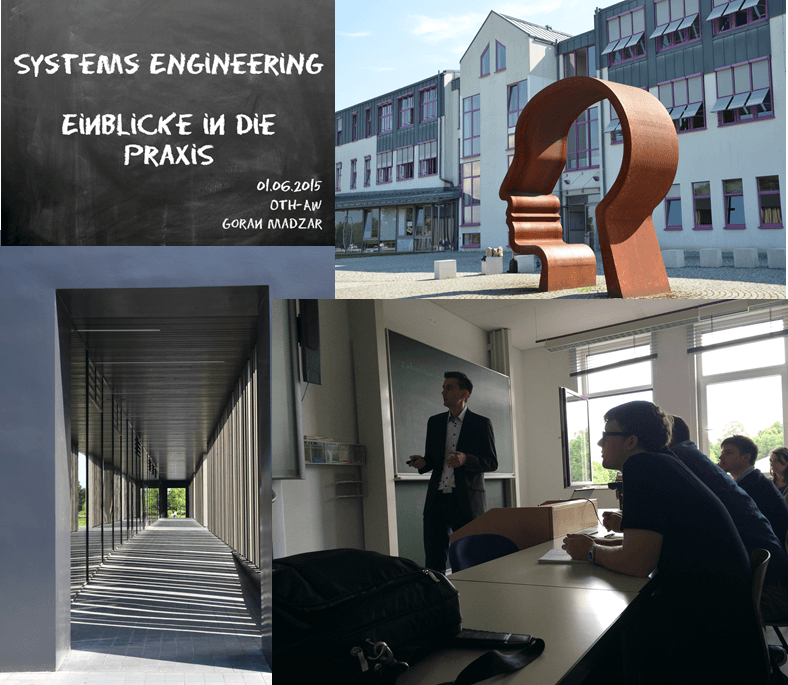
Last Monday (June 1, 2015), I was privileged to give a guest lecture on my favorite subject, Systems Engineering, at the Ostbayerische Technische Hochschule (OBT) in Weiden. In Professor Clemens Bulitta's Master's program in Medical Engineering, I gave the students practical insights into the field of Systems Engineering. I spoke about:
- Career of a systems architect
- Approach to the development of medical devices
- Roles and people in a development project
- Why system architects are needed and what they should be able to do
- Model-based development and tools
- Creation of a system architecture
- Joint creation of an architecture based on a product example
The guest lecture consisted of two 90-minute sessions. In the second part, the students worked in three teams to identify the product's interfaces, functions, and components based on a medical technology product. I thoroughly enjoyed seeing how the students mastered the tasks assigned to them, and I'm delighted that the topic of systems engineering is being addressed early on at universities.
It was a great pleasure for me to share my experience in this field with motivated and interested students. I believe that systems engineering will become increasingly important in the future.
Here are some pictures and impressions from the university and the event.
 Link to the university:
Best regards
Goran Madzar