

Regional, traceable, resilient: Why MedTech is reinventing its supply chains
Global MedTech supply chain at its limit
At the same time, the global supply chain is increasingly under pressure from geopolitical tensions, trade sanctions, and disrupted transport routes. What was once a calculable cost model is becoming a strategic risk to availability, quality, and compliance.
At the same time, regulatory requirements such as the MDR, IVDR, and ISO 13485 are tightening expectations for transparency and control. Suppliers and outsourced processes must not only be known, but also actively managed and remain fully traceable. This transforms the supply chain into an extension of the company's own quality management system.
Many MedTech companies are responding with a clear change in strategy: away from the lowest unit price and towards more regional, transparent, and resilient supply chains. The focus is increasingly on stable partnerships and value creation that remains operational even in times of crisis.
Dependencies and geopolitics: When supply chain risks become clinically relevant
For many MedTech manufacturers, China remains the central sourcing market for electronics, plastic components, packaging materials, and intermediate products. This concentration on one region has long been economically advantageous: low unit costs, high production capacities, well-established supply chains, and the manufacturing quality of Chinese manufacturers has reached a respectable level over the decades.
The COVID-19 pandemic has demonstrated how quickly a cost risk can escalate into a supply risk. In medical technology, this directly impacts surgical planning, intensive care, and the treatment of chronically ill patients. The risk thus shifts from the supply chain to the hospital: delayed deliveries, limited availability, or short-notice product discontinuations can severely disrupt the planned treatment pathway.
Furthermore, political interventions, such as export restrictions, for certain high-tech components or raw materials are difficult to predict, and conventional safety stocks cannot be arbitrarily increased. At the same time, regulations like the MDR and IVDR are tightening the requirements for changes in the supply chain: Changing suppliers quickly has become significantly more complex from both a regulatory and quality perspective. MedTech companies are therefore beginning to identify their dependencies on China, develop alternatives, and evolve their procurement strategy from a single source in Asia to more diversified and regionally based structures.
MDR, IVDR and UDI: The supply chain is becoming a high-risk area
With the MDR (EU Medical Device Regulation) and IVDR The EU's In-Vitro Diagnostics Regulation places a significantly stronger regulatory focus on the supply chain. The manufacturer bears overall responsibility for the product, including all outsourced processes, subcontractors, and critical suppliers.
This is particularly noticeable with traceability and UDI (Unique Device Identification). Serial numbers, batches, component and material flows must be documented in such a way that it can be proven where a component originated and in which products it was installed. Without this transparency, not only do liability risks and audit findings increase, but also the duration and complexity of corrective and preventive actions (CAPA).
This effectively turns the supply chain into a high-risk area: Insufficiently qualified suppliers, poorly documented changes, or unclear responsibilities can lead to products not reaching the market or reaching it late. MedTech companies that integrate regulatory requirements into their supply chain strategy early on therefore gain not only compliance assurance but also speed up the approval process.
ISO 13485 as a compass for supplier management
ISO 13485 translates these regulatory requirements into concrete expectations for quality management and thus directly into supplier management. It requires structured processes for the selection, evaluation, and monitoring of suppliers, especially when they handle product-related or regulated processes. The central question is: Does the supplier demonstrably contribute to ensuring product quality and safety?
In practice, this means: risk-based supplier classification, clearly defined quality requirements, documented qualifications, and regular re-evaluations. Audits, quality agreements (QAAs), and performance indicators are becoming standard tools to ensure that external partners consistently meet the requirements of ISO 13485, MDR, and IVDR.
This also changes the role of the supplier: the classic "supplier" becomes a certified partner closely integrated into change and risk management processes. Companies that structure their suppliers according to ISO 13485 create a basis for reshoring and regionalization and reduce the risk of the supply chain becoming a regulatory bottleneck.
Regional, traceable, resilient: New guiding principles for supply chains
The new supply chains for medical technology are less about the question "Where is it cheapest?", but rather "Where is it reliable in an emergency?".
Regionality This plays a central role: Shorter transport routes, similar legal frameworks, and cultural proximity facilitate communication, audits, and compliance with regulatory requirements. At the same time, European or national value creation helps to reduce vulnerability to global crises.
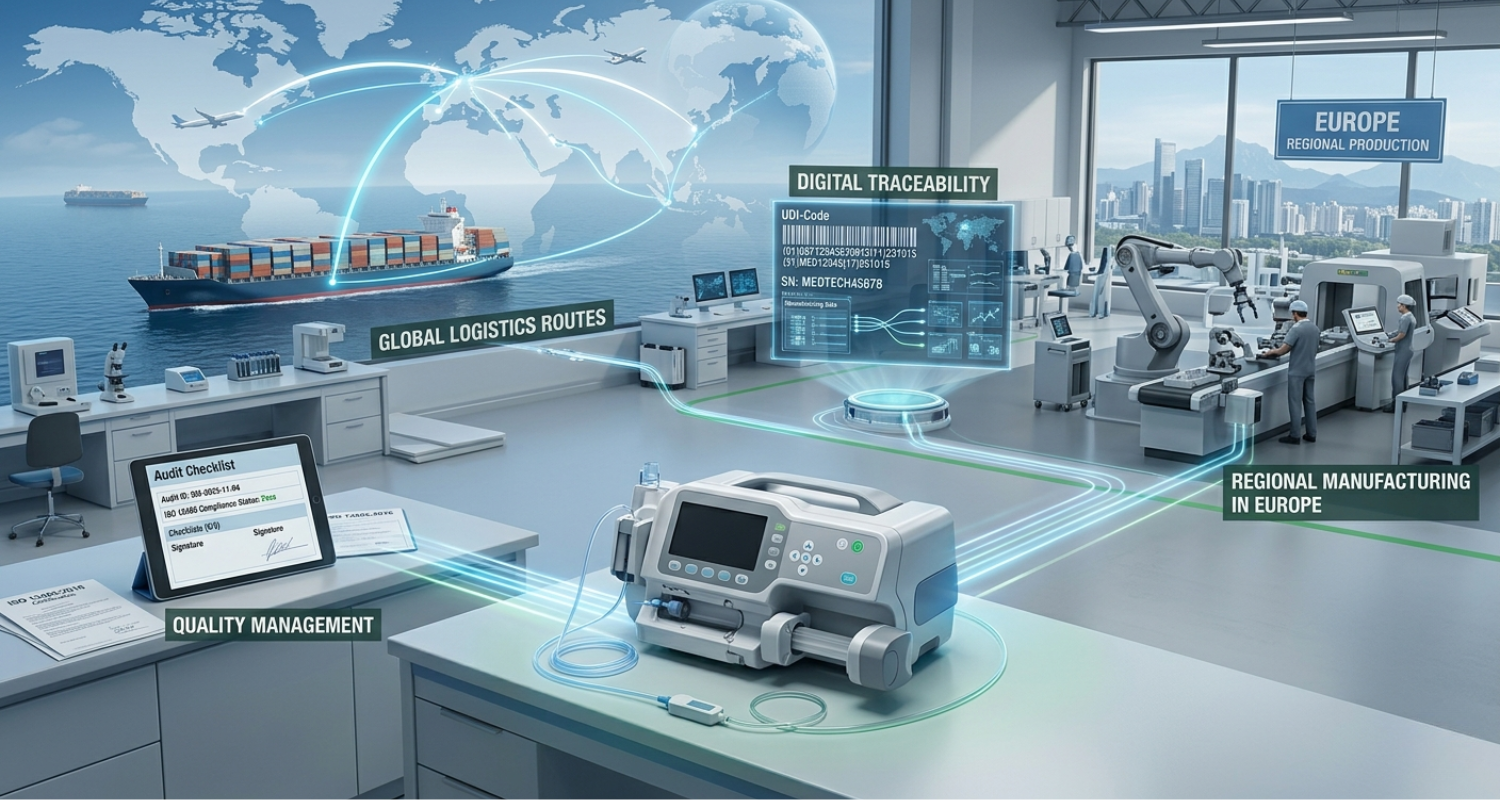
Traceability This becomes the second guiding principle. Transparent material and information flows make it possible to quickly identify anomalies, conduct targeted recalls, and thoroughly analyze the causes. Technically, this often means: digital traceability, structured master data, and clean interfaces between ERP, QMS, and production systems.
Resilience This is the third guiding principle. Instead of relying on single-source dependencies, there is an increasing focus on dual- or multi-sourcing, strategic safety stocks, and clearly defined contingency plans. Resilience means consciously prioritizing: Which components are clinically critical, difficult to substitute, or regulatory sensitive and therefore require special attention in the supply chain?

Strategic realignment of supply chains
The first step towards a future-proof supply chain strategy is transparency. MedTech companies should systematically map their existing supplier landscape: Which materials and components come from whom, from which regions, with what delivery times, risks, and regulatory dependencies?
Prioritization follows this process. Critical components receive greater strategic attention. For these "A-components," alternative suppliers are specifically developed, regional options are researched, and clear quality requirements are defined. Reshoring or nearshoring, i.e., relocating production back to regional or supra-regional locations, is one component, but not the sole solution.
The next step involves adapting processes and governance: supplier classification, quality agreements, and escalation paths are integrated into the existing QMS. Simultaneously, investing in digital tools that make delivery performance, quality data, and traceability visible is worthwhile. This creates a supply chain that is not only regulatory compliant but also strategically sound: it withstands crises, remains auditable, and becomes a genuine competitive advantage in medical technology.
The MedTech Supply Chain 2027: Why regional, traceable and resilient will be crucial
By 2027, the requirements for high-performance supply chains in medical technology will have shifted significantly. The decisive factor will no longer be solely the cost structure, but rather the ability to flexibly, transparently, and robustly integrate development, production, and quality assurance.
Digital traceability solutions are becoming the standard: material flows, batches, UDI data and supplier-related quality indicators can be consistently mapped in integrated systems.
Companies that invest early in regional structures, digital traceability and robust quality processes create a real competitive advantage: They shorten development cycles, reduce dependencies and accelerate the path to approval.
In practice, this shift is primarily evident in local manufacturing capacities, integrated testing environments, and a closer integration of development and production. Global supply chains remain relevant, but are used more strategically and later in the product lifecycle.
This creates a supply chain that is not only efficient, but above all resilient and future-proof.