

How do you create an architecture for a mechanical specification? I want to answer this question in this blog post. A system consists of various components that are connected to each other electrically, mechanically, optically, or pneumatically. But how can this be represented in a specification?
In my work as a systems architect, mechanics play an important role. Mechanical architecture is fundamental to a good product. Therefore, it's worth considering the mechanics.
I'm modeling the mechanics in SysML using Enterprise Architect. I'd like to demonstrate my approach using a simple example (a non-invasive blood pressure monitor – NIBP).
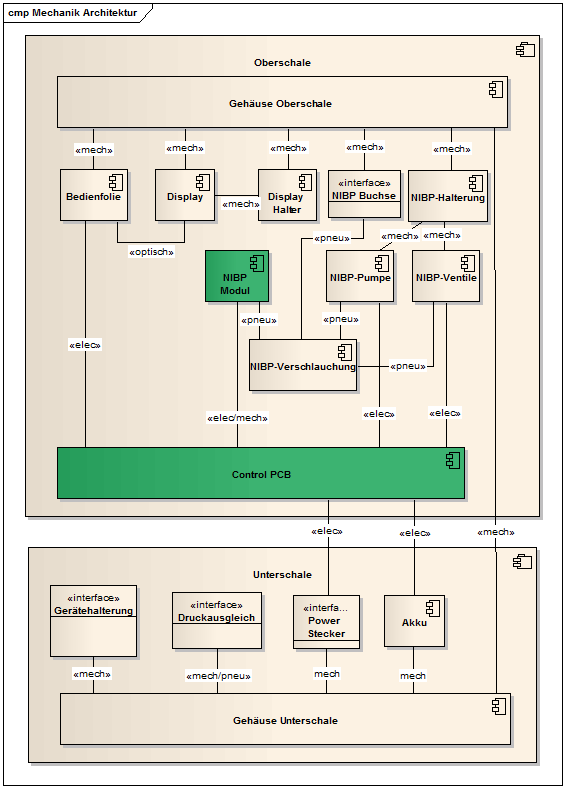
First, I will define the necessary components and structure them. This example shows a simple blood pressure monitor (NIBP), which consists of two shells with internal electronics and pneumatics. The cuff is connected externally to a socket. The device has a control panel with buttons for control and a display for showing the measured values. The device has an internal battery and can be powered externally via a power adapter. A pressure equalization vent allows pressure to be equalized between the device's interior and the environment. A device holder is used to secure the device.
|
|
| Dipl.-Ing. Goran Madzar, Partner, Senior Systems Engineer E-mail: madzar@medtech-ingenieur.de Phone: +49 9131 691 240 |
|
Do you need support with the development of your medical device? We're happy to help! MEDtech Ingenieur GmbH offers hardware development, software development, systems engineering, mechanical development, and consulting services from a single source. Contact us. |
|
For modeling, I use a component diagram. In this diagram, the components are modeled using "Component" elements. I can store information about the components in these elements, which is then derived in the architecture specification. I use "Interfaces" to model interfaces. "Packaging Components" allows components to be grouped together in a structured manner. This is illustrated in the example for the lower shell and upper shell. Finally, the components are connected to each other using an "Associate" line. I assign a stereotype to this connection. In the example, I distinguish between mechanical, electrical, optical, and pneumatic interfaces.
What is the point of this representation?
This representation illustrates the mechanical architecture, a kind of block diagram. It provides an overview of the components used and the interfaces between them. These interfaces can also be very useful when conducting a mechanical FMEA.
Further information
The architecture presented here is only one view of the mechanics. A mechanical specification also includes other representations. For example, it is important to specify the arrangement of components in 3D. Furthermore, the design specifications for the product must be presented. This makes it easy to visualize what the product should look like.
If you have any questions or would like to discuss things with me, I am happy to help and advise you.
I welcome feedback and would love for you to contact me. Feel free to leave a comment on the article. If you know someone who might also be interested in the blog, I'd be very happy if you would recommend it.
Best regards
Goran Madzar