

Self-praise stinks! I agree. But in this case, it's not a problem, because the lack of browser-based smell support means there's no burden on readers ;-) So, what's the point?
A long time ago, I was suffering from my inadequate mental arithmetic skills – and they certainly haven't improved over the years. So I started "carving" a small tool to make it easier for me to convert from decimals to hex and various other number systems. (Note: If the saying "A fool with a tool is still a fool" springs to mind here – that's certainly true :-D )
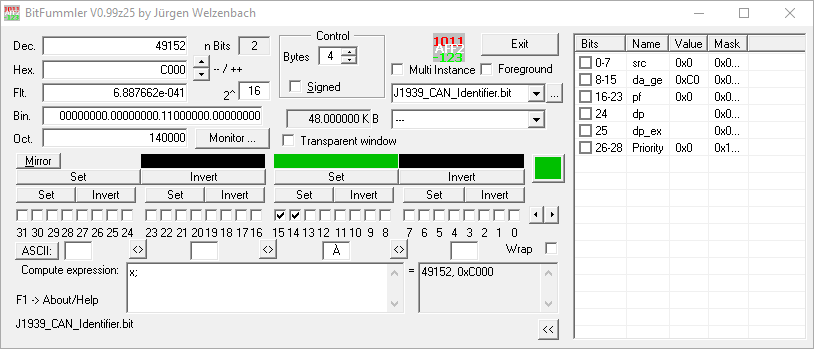
Gradually, further functions were added, some at the suggestion of the growing user community, such as
- Set/Clear/Invert bits/bytes/words
- Reflect
- Rotate (Left/Right with and without wrap)
- ASCII input/display
- Signed/Unsigned
- a simple C code parser (simply driven by curiosity to implement something like this with Lex/Yacc)
- the display of Windows error codes or similar in text form (although this can now be done more quickly using a search engine – as I said, the BitFummler has already had a few years of experience on its virtual silverback).
Sometimes it is also helpful to display the #define associated with a value – a simple C header parser makes this possible. - Representation of the 32-bit value as a bit field – freely configurable
- and much more
The BitFummler is available for download at heise.de.
Have fun—er, trying it out. Bug reports and feature requests are, of course, welcome.
Jürgen Welzenbach