

The task of the system architect is to break down a system into simpler subsystems. The subsystems are then initially developed separately and later reunited. This merging is called integration. But how does such an integration work, and what needs to be considered?
Integration strategy
There are two approaches to integration. The first is the so-called “Big Bang” method. Here, everything is simply assembled and then the integrated system is tested. This approach may be feasible for simple, manageable systems. However, for more complex systems, this approach is not satisfactory, as it becomes difficult to locate the cause of errors. In this case, a incremental approach significantly easier. Incremental means integrating and testing subsystems step by step, from the bottom up. The following figure shows how this can work.
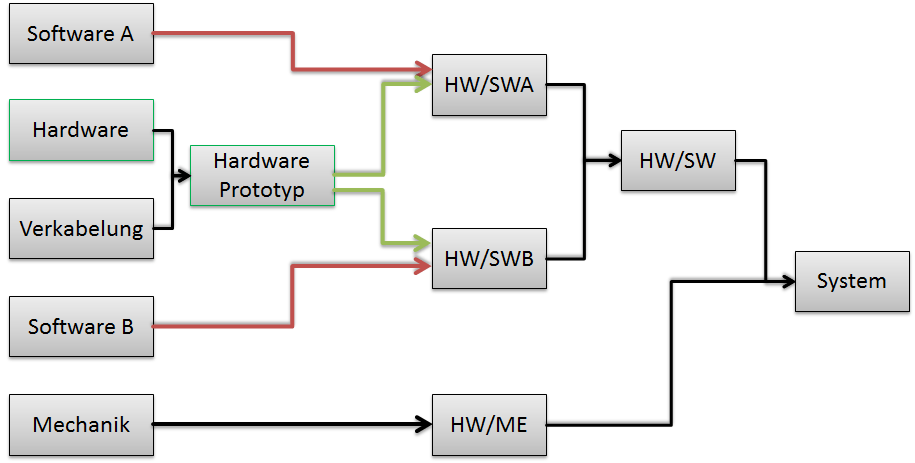
This kind of representation can be used to plan the integration steps. It can be easily integrated into an integration plan to visualize the process.
|
|
| Dipl.-Ing. Goran Madzar, Partner, Senior Systems Engineer E-mail: madzar@medtech-ingenieur.de Phone: +49 9131 691 240 |
|
Do you need support with the development of your medical device? We're happy to help! MEDtech Ingenieur GmbH offers hardware development, software development, systems engineering, mechanical development, and consulting services from a single source. Contact us. |
|
The integration plan
If you want to plan the integration thoroughly, an integration plan is a good idea. The integration plan describes how the individual subsystems will be integrated into the overall system. It describes the integration steps and their sequence. After each integration step, integration tests can be conducted to verify functionality. When planning the integration, it is important to consider resources and allocate personnel, equipment, space, and special resources. Finally, it is important to consider the effort involved and how much time and money will be required for the integration.
Therefore, the following points should be considered when developing an integration plan:
- How do I access the integrated system?
- Which integration steps and which sequence are necessary?
- Which integration tests are necessary?
- What resources do I need?
- staff
- Equipment
- Premises / Special funds
- What accessories do I need for my system?
- How much will I spend (time and money)?
Integration is a challenging task, but it can also be a lot of fun. As a systems engineer, you can delve deeply into the technology and analyze the interactions between subsystems. Integration allows you to identify the weak points of the architecture and thus gain valuable insights that will help you develop systems better in the future.
I'm very happy to receive feedback and engage with you. Feel free to comment on this article. If you know someone who might also be interested in the blog, I'd be delighted if you would share it with them.
Best regards
Goran Madzar