

The new EU Battery Regulation The regulation was adopted in 2023 and is being phased in. The Battery Directive 2023/1542 can have a significant impact on medical technology, particularly on medical device manufacturers. It can lead to a complete redesign of the mechanics and electronics and require the products to be recertified.
The basic rule applies to portable batteries. February 18, 2027The battery must be easily removable and replaceable throughout the product's lifespan. However, Article 11 provides for exceptions, particularly in cases where replacement by the End users is problematic from a security perspective or a permanent connection is required for the battery for safety reasons.
Many medical technology manufacturers are currently asking themselves the same question:
- Will batteries in the future necessarily have to be replaceable by the end user?
- And does that mean a redesign of existing products?
The short answer is: Not necessarily, but very likely!
In this article, we provide an overview of...,
- what the EU Battery Regulation 2023/1542 requires of medical technology,
- from when the regulation takes effect,
- what specific impact it has on medical devices,
- and what manufacturers should do now to avoid risks.
What does the new EU Battery Regulation 2023/1542 regulate in medical technology?
Regulation (EU) 2023/1542 completely replaces the previous Battery Directive 2006/66/EC. The EU's aim is to regulate the entire life cycle of batteries more effectively, from production and use to take-back and recycling.
The regulation applies in principle to all batteries, including:
- Device batteries,
- Batteries that are built into products,
- and therefore explicitly also for medical devices.
Therefore, the Battery Directive 2023/1542 also applies to medical technology, since it all battery categories This applies regardless of whether the battery is sold separately or integrated into a product. Medical devices are not generally exempt in this application.
Article 11(1) requires that portable batteries be used for the End users easily removable and replaceable throughout the product's lifespan. According to the regulation, "easily removable" means: removal with commercially available tools, without special tools, proprietary tools, heat or solvents; furthermore, products must be accompanied by instructions and safety information regarding use, removal and replacement.
The Commission notice adds that the obligation relates to the entire battery, not just referring to individual cells, and that the end user is an adult without special qualification It is to be understood. She also clarifies that software can be replaced by a compatible one. battery must not obstruct.
For manufacturers, the decisive factors are the gradations in Article 11, paragraphs 2 to 4. The Commission notice lists the following among the partial exceptions specifically products for wet areas as well Medical devices and in-vitro diagnostics under the heading „Removability and interchangeability by independent experts“.
This is the crucial point for MedTech: The stronger, and usually more legally sound, position is often... „"not by end users, but only by qualified professionals"“, not automatically "only by the manufacturer". full exception Paragraph 3 is narrower: it only applies where a continuous power supply and a permanent connection to the battery are required for safety or – in the case of data-driven products as the main function – for data integrity.
Paragraph 4 provides for additional product-specific exemptions by delegated act if there are scientifically substantiated safety concerns or if there is a risk of conflict with product safety requirements of Union law.
A key point for manufacturers is therefore Article 11 of the regulation.
The relevant deadlines from the Battery Regulation 2023/1542 can be summarized for medical technology and manufacturers as follows: Regulation in force since August 17, 2023, general application from February 18, 2024, Commission Notice on Article 11 on January 10, 2025, Task 1 Report in November 2025, and applicability of Article 11 from February 18, 2027.
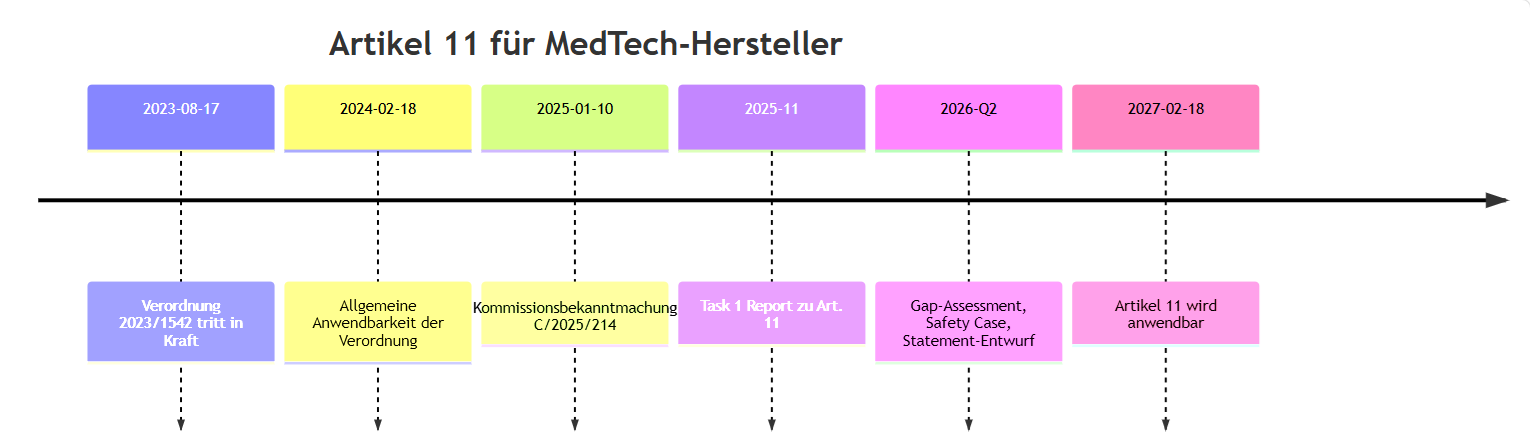
Article 11: Removable and replaceable device batteries
Article 11 stipulates that device batteries should, in principle, be removable and replaceable by the end user.
This very point is currently causing uncertainty in many development and regulatory teams. Because numerous medical devices are:
- safety-critical,
- electrically complex,
- Designed for home use,
- or deliberately designed to be compact.
A redesign is expensive and not planned for by many manufacturers. The good news: The regulation explicitly provides for exceptions.
option | Cost | schedule | Regulatory risk | Usability | Security and testing effort |
|---|---|---|---|---|---|
Redesign for end-user switching | High | Long | Medium to high, due to housing, IFU, RMF, verification and possibly NB effects | Seemingly comfortable for users, but only if truly robust and easy to use for laypeople. | Very high: electrical safety, IP rating, EMC/ESD rating, mechanical integrity, usability |
Replacement only during the service process by qualified specialists | Lower | Shorter | Often the more defensive approach, provided the security rationale is clearly documented. | Less comfort, but a clearer and more controlled process. | Significantly more focused: service validation, inbound/outbound inspection, documentation |
Manufacturer-only, no access for other professionals | Low to medium in design, but high in justification. | Medium | Higher if the legal basis is not secured by Article 11(3) or very strong security arguments. | Simple for end users, but sensitive in terms of repair-free operation. | Focus on legal justification, safety case and consistent documentation chain |
What the guideline and Task 1 report mean for manufacturers
Commission Notice C/2025/214 is not legally binding, However, it is highly relevant for official and notified practice. It explicitly states that the binding interpretation of EU law rests solely with the CJEU, but aims to support a harmonized application of Article 11.
Three clarifications are particularly useful for manufacturers:
- „Removability“ is always associated with the preservation of Function, Performance and safety thought through together.
- The announcement describes "independent experts" as economically active actors with the technical expertise to repair the product.
- Does it limit the full exemption for Data integrity Narrowly defined: The main function of the product must be data collection/provision; mere ancillary data is not sufficient.
The Task 1 Report The document from 2025 is also not a legally binding act, but rather technical support for the Commission in preparing possible delegated acts. This is precisely why it is strategically useful for manufacturers: it shows how submitted safety arguments are likely to be interpreted.
The most important message is: The suggestion that an end user might perform the exchange incorrectly is not sufficient in itself., if this risk could be avoided by following the manufacturer's instructions. At the same time, the report makes it clear that successful applications resolve the conflict with specific standards or EU legal safety requirements They must be properly documented.
For MedTech teams, this means that a good position statement requires not only plausibility, but also an orderly chain of product architecture, intended use, risk management, standards and verification evidence.
Non-replaceable battery? That's still permissible – but only with justification.
Article 11, paragraph 3 of the Battery Regulation clarifies that end-user removability is not required if this would:
- the safety of the user or patient,
- the functionality of the product,
- or compliance with other EU legal acts (e.g. MDR)
would be affected. This is a crucial point for medical devices.
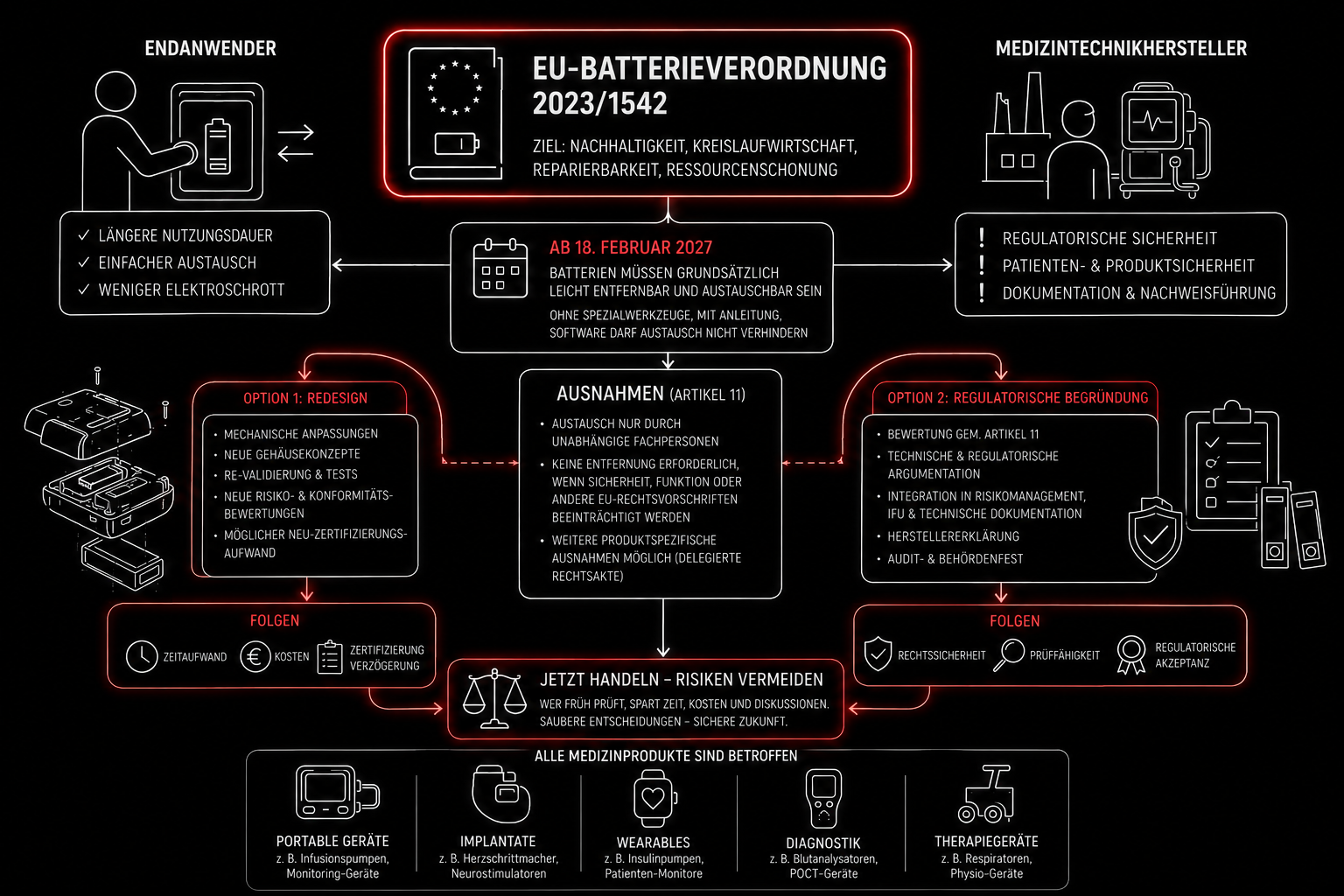
Redesign or justification – what manufacturers must decide now
For many companies, the battery regulation represents a strategic crossroads:
Option 1: Product redesign
- mechanical adaptation for replaceable battery,
- new housing concepts,
- Re-validation,
- renewed risk and conformity assessments.
This is complex, expensive, and not always practical.
Option 2: Justified non-extractability
- clean assessment in accordance with Article 11,
- technical and regulatory arguments,
- Integration into risk management, IFU and technical documentation,
- Audit- and authority-compliant manufacturer's declaration.
In many cases, this is the more realistic and regulatory-compliant approach, especially for existing products.
Why taking action now is crucial
Many manufacturers are still unaware that their products are affected. Others assume that the regulation "won't affect medical devices." Unfortunately, that's not the case. The Battery Directive applies directly as an EU regulation. Transitional periods are already underway. Notified bodies and market surveillance authorities will be addressing the issue.
Those who only react when questions are asked are too late.
How MEDtech engineers can support you
As an engineering partner for medical technology, we support manufacturers in areas including:
- the structured assessment of Article 11 for your product,
- the decision redesign vs. regulatory justification,
- the preparation of verifiable manufacturer's declarations / statements of facts,
- the integration into risk management, IFU and technical documentation,
- preparing for audits and inquiries from notified bodies,
- the adaptation of the devices, if necessary,
- professional battery replacement of your medical devices as a service provider.
Our approach is always practical: as little redesign as necessary and as much regulatory certainty as possible.
Conclusion – Battery Regulation 2023/1542 in medical technology
The EU Battery Regulation is not a fringe issue. For many medical technology manufacturers, it affects concrete product decisions.
- Batteries do not necessarily have to be replaceable.
- However: Every decision must be justified, documented and comprehensible.
- Acting now saves time, costs, and discussions later.
Anyone who needs a robust position on Article 11 for an active medical device should not work with individual arguments in emails, but with a short, formally structured dossier consisting of a statement, evidence matrix and service concept.
MEDtech Engineer supports the preparation of these documents, from the scope review and safety argumentation to the final manufacturer's declaration.