

- Common mode test
Apply a defibrillation pulse to all interconnected patient terminals against protective conductors or earth. Ensure that no hazardous voltages are present at any other outputs and connections (and accessible metallic parts).
- Differential clock test
Apply a defibrillation pulse to each patient terminal individually, with the other patient terminals connected to ground. Again, no hazardous voltages may be present at any other outputs or terminals.
- Energy reduction test
The energy delivered to the patient may be reduced by a maximum of 10 % by a defibrillation-protected applied part, so that the effectiveness of the defibrillation is maintained.
After all tests, the basic safety and essential performance characteristics of the tested device must still be met. The tests and corresponding test setups are described in detail in 60601-1 and will not be discussed further here. The setup is shown in principle in the following figure.
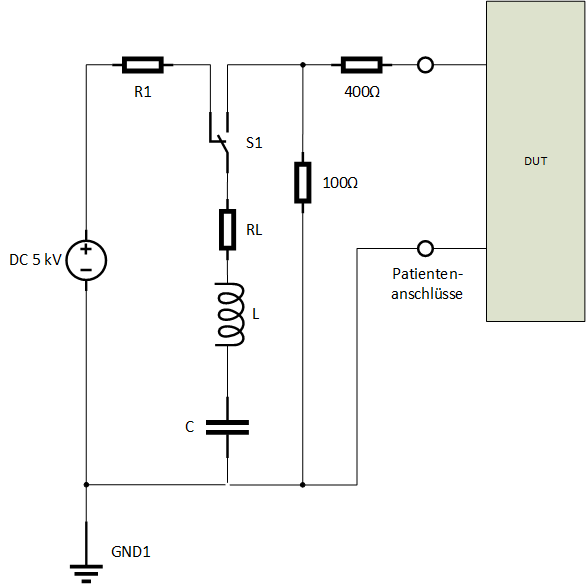
In addition, there is a requirement that the clearance and creepage distances of defibrillation-protected application parts must not be less than 4 mm.
What does the requirement for a defibrillation-protected application part mean in development?
For defibrillation-protected devices with a galvanic connection to the patient, such as ECG machines or other stimulation devices, the patient connections must be appropriately protected. There are various topologies for this protection circuit, but essentially the protection circuit consists of a series resistor for current limiting and a component for voltage limiting, such as a diode, Zener diode, or gas discharge tube.
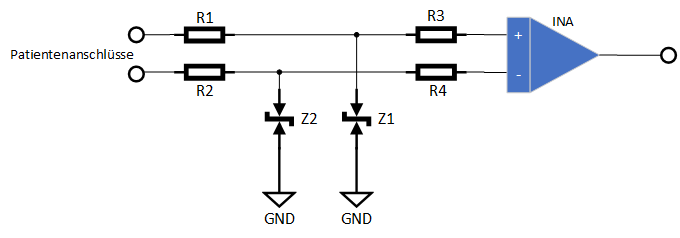
Component specifications vary depending on the application. For example, an ECG input stage should generally have the following characteristics:
- Series resistance in the range of 5 kOhm to 50 kOhm for current limiting
The series resistance must be specified for:
- Pulse load
- Dielectric strength
- Required air and creepage distances
Bypass diodes such as MAX30034 or BAV199 specified for:
- Pulse load
- Electricity
Once a circuit topology has been chosen for the input circuit, it can be easily simulated with Spice. This simplifies component dimensioning, as measurements at high voltages are not so straightforward and subject to significant noise.
If you have any further questions on this topic, please leave us a comment or send us an email.
Martin Bosch