

This is precisely where the IEC TS 60601-4-2 on. While most manufacturers meet the basic requirements of IEC 60601-1 and the EMC collateral standard IEC 60601-1-2 While some documents from the same family of standards are well-known, others are often less familiar.
In addition to international standards, the IEC also publishes Technical Specifications (TS) and Technical Reports (TR). These documents contain additional guidelines and recommendations for the application of existing standards. The IEC published the Technical Report back in 2016. IEC TR 60601-4-2. In 2024, this was changed by the Technical Specification IEC TS 60601-4-2 replaced.
What is IEC TS 60601-4-2?
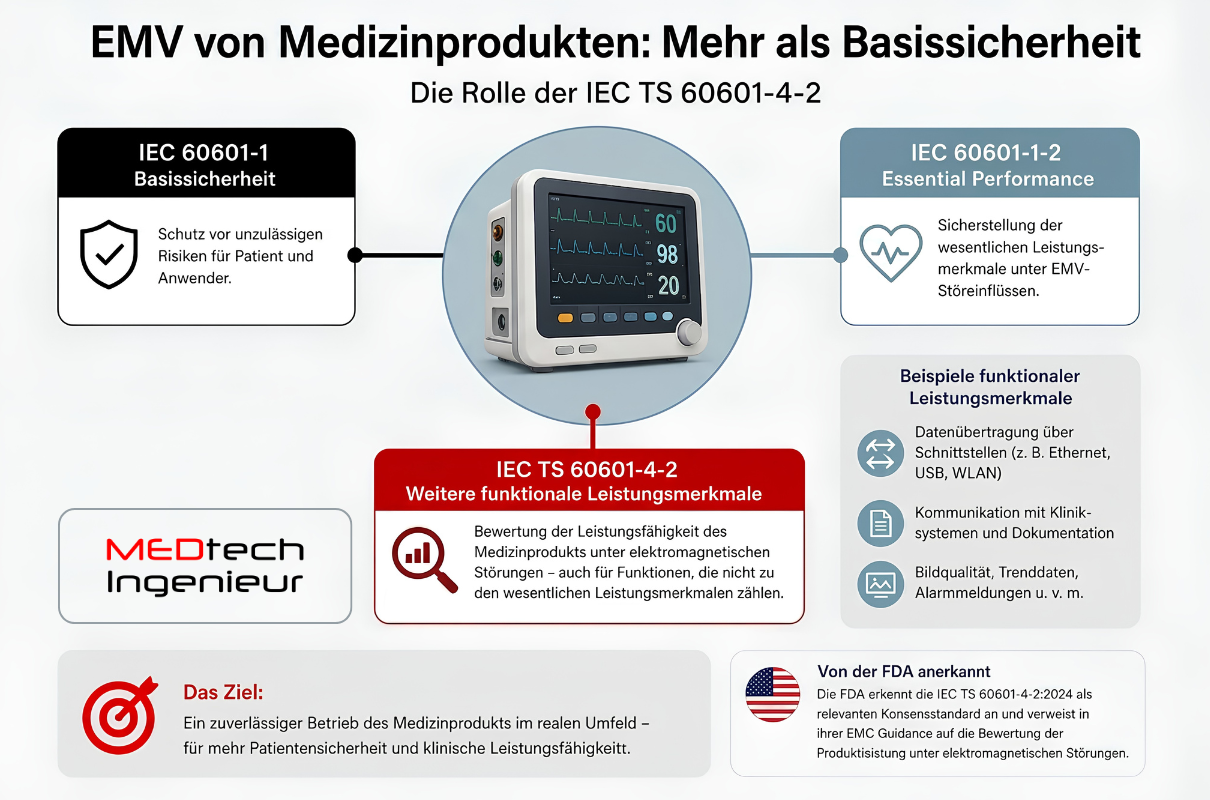
Why is considering basic security and essential performance not always sufficient?
The classic EMC assessment of medical devices focuses on the question of whether electromagnetic interference can pose a risk to patients or users. For this purpose, basic safety and essential performance are considered in particular.
In practice, however, many medical devices have functions that go beyond this safety consideration. These functions may not be directly safety-critical, but can be crucial for the intended use.
A ExampleA medical device can store, transmit, or display measurement data. If these functions are affected by electromagnetic interference, there may be no immediate safety risk. However, faulty or lost data can influence further diagnosis or treatment decisions.
IEC TS 60601-4-2 therefore broadens the perspective: Not only safety-critical functions must be considered, but also other functions that are relevant to the intended purpose of the medical device.
The terms can be simplified and distinguished as follows:
Expression | Meaning |
|---|---|
Basic security | Protection against unacceptable risks from hazards to the medical device |
Essential Performance | Functions whose failure or deterioration could cause an unacceptable risk |
Functional performance characteristics | Other functions that are relevant for the intended use |
What functional performance characteristics does IEC TS 60601-4-2 consider?
- the ability of an ultrasound device to print an image via an interface,
- the ability of a patient scale to accurately measure a patient's weight,
- the correct transmission or storage of measurement data,
- The reliable presentation of information for the user.
How can manufacturers implement the requirements of IEC TS 60601-4-2?
- Identify relevant functions
All functions of the medical device should be evaluated with regard to their relevance to its intended purpose. - Define performance criteria
For relevant functions, it should be defined what behavior is acceptable during and after electromagnetic disturbances. - Derive test requirements
The defined criteria must be integrated into suitable EMC tests so that product performance can be evaluated under interference. - Document results
The assessment and test results should be transparently incorporated into the technical documentation.
Conclusion: IEC TS 60601-4-2 expands the consideration of EMC requirements.
IEC TS 60601-4-2 expands the scope of EMC testing for medical devices. In addition to basic safety and essential performance, it also focuses on other functions that may be relevant for the intended use of a medical device.
For manufacturers, this means that functional performance characteristics should be taken into account during product development and when preparing for EMC tests.
A structured evaluation of these functions not only supports a better EMC strategy, but also creates a solid basis for technical documentation and international approvals.
We support medical device manufacturers in defining suitable performance criteria and preparing for EMC tests according to IEC 60601-1-2 and IEC TS 60601-4-2. Contact us for a free initial consultation.
Further information:
- FDA Guidance „Electromagnetic Compatibility (EMC) of Medical Devices“
Link: https://www.fda.gov/media/94758/download - FDA Recognition Database: https://www.accessdata.fda.gov/scripts/cdrh/cfdocs/cfStandards/detail.cfm?standard__identification_no=45396
- IEC TS 60601-4-2:2024 – Medical electrical equipment – Part 4-2 [[webstore.iec.ch]](https://webstore.iec.ch/en/publication/80393)