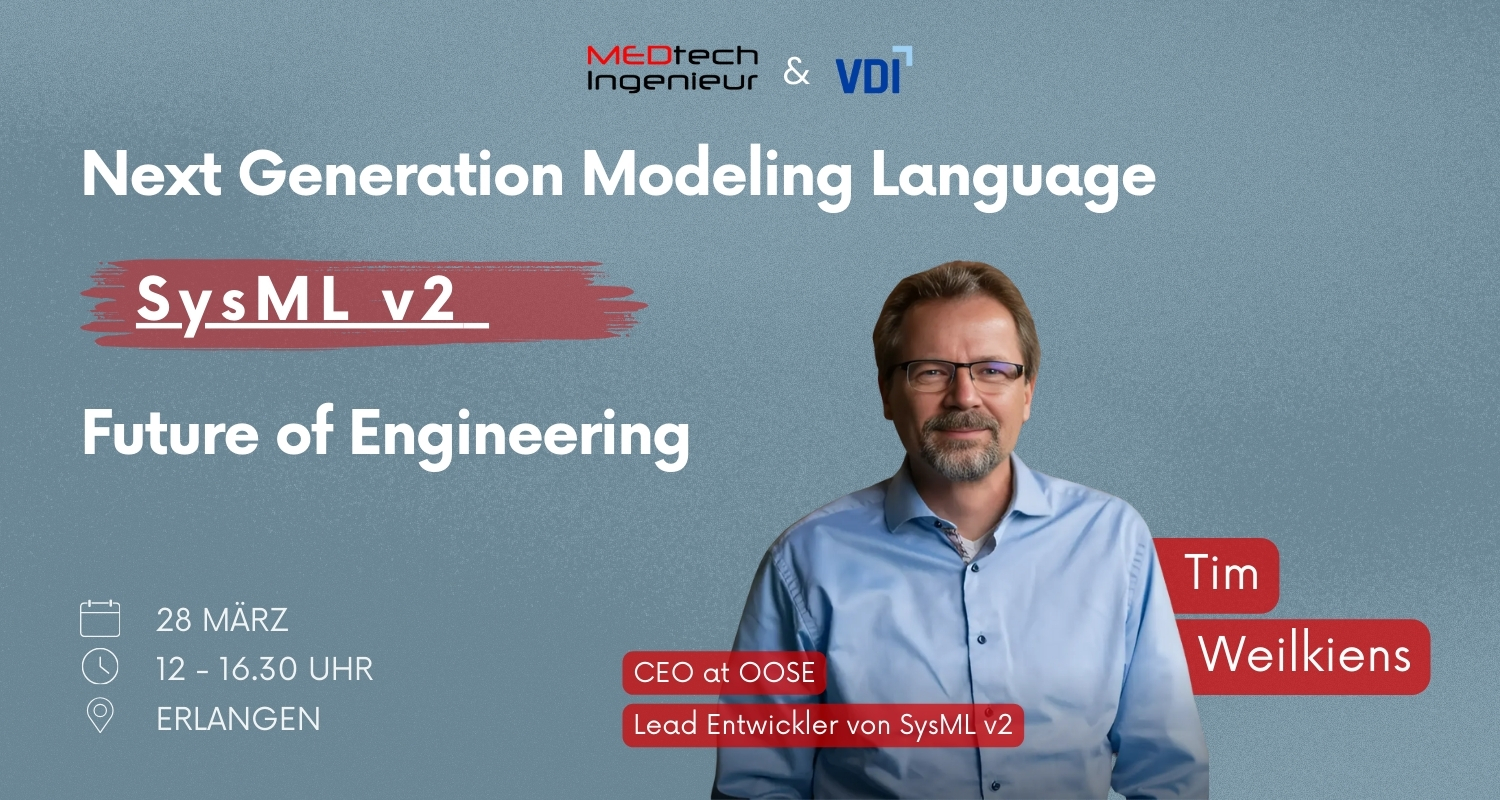
Invitation VDI Event 28 March: SysML v2 – With Tim Weilkiens

Kevin Krannich

19/03/2025


We are pleased to invite you to an exclusive VDI event of the Network Systems Engineering which takes place in our office!

On Friday, March 28, 2025, everything will be about the Next Generation Modeling Language SysML v2 turn – a major evolutionary step in modeling technology that takes software engineering to the next level.

We are particularly proud Tim Weilkiens, CEO of OOSE, co-author of SysML v1, and lead developer of SysML v2, as our keynote speaker! As an expert speaker on the topic, he will personally demonstrate how SysML v2 paves the way for future-oriented technologies such as the Digital Thread and Digital Twin.

When: Friday, March 28, 2025, 12:00 PM
Where: MEDtech Ingenieur GmbH, Am Weichselgarten 7, 91058 Erlangen
Cost: 20 € for VDI members, 35 € for non-members

Register by March 21, 2025 – places are limited to 60 participants!


We look forward to meeting you personally!
Your team from MEDtech Ingenieur


Written by Kevin Krannich

Kevin is a trained marketing specialist and has focused on online marketing. He has been working in digital external communications at MEDtech Ingenieur since 2023.


More articles

  • 26/02/2026
  • General, hardware, quality

According to the German Resuscitation Registry 2024, 370 people per day in Germany suffer a sudden cardiac arrest. That's over 136,000 cases per year, mostly occurring outside of hospitals. ...

Read more
  • 12/02/2026
  • General, hardware, mechanics, technology, testing, validation

How are sensors for cardiopulmonary resuscitation validated? In our case, we specifically asked this question for a sensor used to measure compression depth during resuscitation. Why is a CPR feedback sensor validated? ...

Read more
  • 05/02/2026
  • General, Hardware, Requirements Engineering, Software, Zephyr

What difference can a CPR feedback system make to cardiopulmonary resuscitation? In the event of cardiac arrest, the transport of oxygen to the body's cells stops immediately, leading to irreversible damage. The cells die. ...

Read more