

A doctor's daily work is unimaginable without computer systems. It is therefore all the more important that these systems offer high levels of usability, reliability, and availability. Graphical user interfaces can simplify the operation of medical devices. However, this only works if the selected technologies are adapted to the usage environment and menu structures are logically structured. Users are now familiar with the usability of consumer electronics products and expect this standard for medical devices as well. The user interface is therefore a decisive factor in purchasing decisions.
MEDtech Ingenieur GmbH has developed uiMedical, a platform for the rapid implementation of graphical user interfaces for medical technology. This article will introduce it in more detail.
The platform
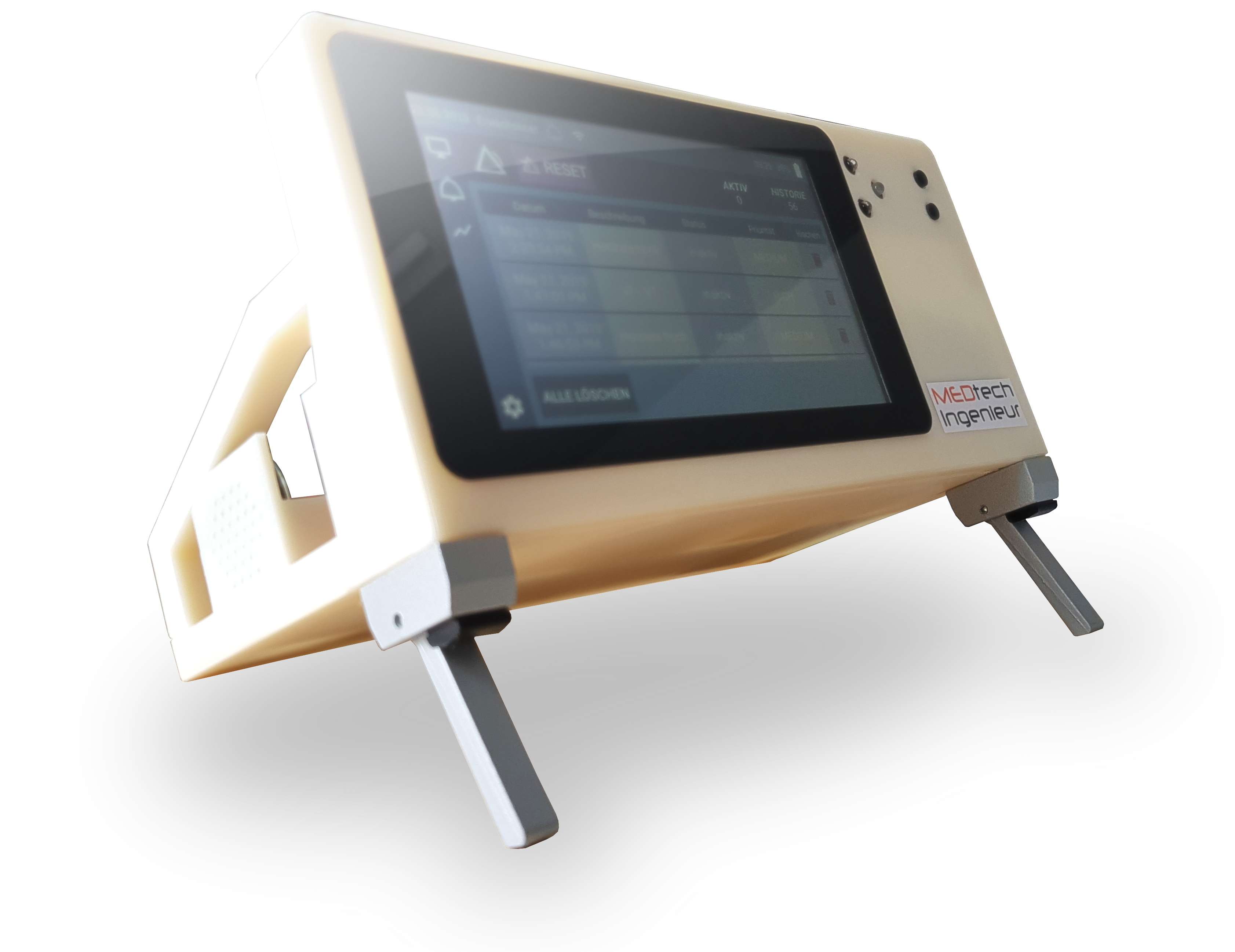
uiMedical allows you to quickly build your own medical devices. The platform features serial interfaces such as UART, SPI, and I2C for connecting sensors and modules such as ECG amplifiers. With two powerful controllers, the platform is future-proof. One controller can perform time-critical tasks and routine tasks such as querying the battery level. Another controller is used to implement the graphical user interface, network connection, file system, and the transmission of user commands. The platform also features an audio amplifier and a speaker. If the medical device is intended for mobile use, power is supplied by a 3000 mAh rechargeable battery with a charge controller and condition monitoring.
Figure 1 shows a test setup. An ECG module, an external brightness sensor, and an NFC module are connected to uiMedical. The patient's ECG is sampled at 500 Hz and visualized on the user interface. The user can adjust various settings on the ECG module. The external brightness sensor allows the screen brightness to be automatically adjusted to the ambient environment. This ensures that the user can read all information even in strong sunlight and is not blinded in the dark. The system can connect to the internet and upload recorded ECGs. NFC transponders can be used for authentication.
Graphical user interface
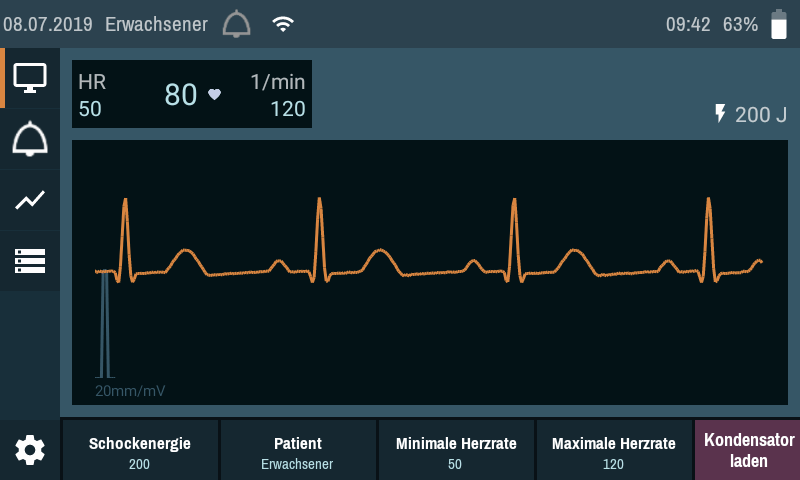
When the demonstrator is switched on, the application starts in the manual view shown in Figure 2. All of the patient's important vital signs are immediately visible. In the demonstrator, this includes the heart rate and the ECG signal. MEDtech engineers adapt the user interface to your requirements and your product. We can handle the entire development process, from the paper prototype to the finished implementation. The GUI can be adapted for both touch operation and operation with hardware buttons. We have experience with various tools, such as QT Creator and Android Studio. By using embedded Linux, you can decide for yourself which tool to use.
contact
Have we piqued your interest? Please contact us by email (info@medtech-ingenieur.de), by phone (+49 9131 691 240) or via our contact form (https://medtech-ingenieur.de/kontakt/).