


Two display types are currently heavily represented in the display market. These include LED and LCD technology. LED displays, in turn, come in two forms.
LED displays
LED displays are available with so-called inorganic single-crystal LEDs and with organic LEDs. Large billboards are manufactured with inorganic single-crystal LEDs because the size of a single pixel is not visible to the human eye due to the great distance from the billboard. The technology that is more interesting for medical technology is so-called organic LED displays (OLEDs). OLED displays are self-luminous displays. They are constructed in several layers (see Figure 1). The outer layers form the anode and the cathode. The anode must be transparent to light, which is why indium tin oxide (ITO) is used. The cathode is made of metals such as magnesium or aluminum, as it must release electrons even with a low energy input. The anode is followed by the hole injection layer and transport layer. These transport the holes to the emission layer (luminophore), where they recombine with electrons. This recombination results in the release of photons. The emission layer is followed by a hole blocking layer, electron transport layer, electron injection layer and finally the cathode [Electronics 2018].
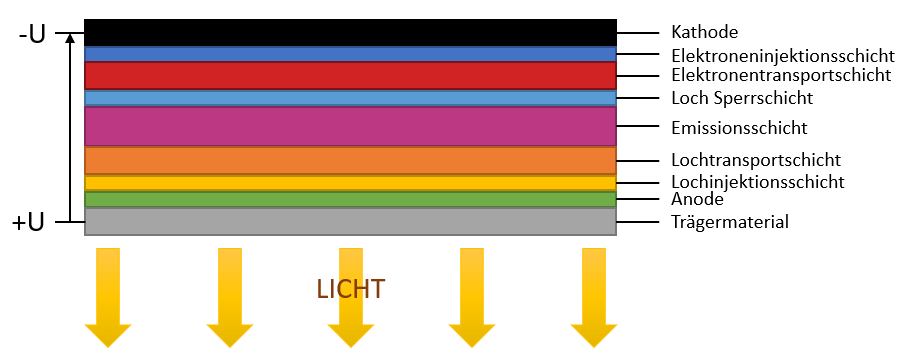
The advantages of OLED technology over LCDs are:
- Production of any shapes
- Very thin and flexible
- Shorter switching times
- Better contrast
- Better black tone
- Very stable viewing angle
- Reducing energy consumption in dark images
However, there are also serious disadvantages. Their lifespan is relatively short compared to LCDs. The lifespan refers to the time until the luminance drops by half. Increasing the luminance accelerates the aging process. Furthermore, the emitter pigments are very sensitive to oxidation and moisture and therefore require particularly precise manufacturing [Electronics 2018].
Liquid Crystal Displays (LCD)
Liquid crystal displays (LCDs) always require a backlight. The cells consist of two polarizing filters and a liquid crystal layer. Light propagates in the form of a transverse wave. This type of wave propagation is polarizable, which means that certain vibration planes can be filtered out. The result is linearly polarized light. The first polarizing filter is responsible for this task. A second polarizing filter is positioned at a 90° angle to the first, blocking the light exit. The liquid crystal layer placed between the filters has the property of rotating the vibration plane of light. Applying a voltage creates an electric field that aligns the liquid crystals, causing the polarized light to rotate. If the light is rotated by 90°, it can pass through the second polarizing filter and the cell lights up. By applying varying voltages, angles between 0° and 90° can be achieved, creating shades of gray. The current control technology for LCD cells is called thin film transistors (TFTs) [Electronics 2018]. This article will not discuss TFT technology in more detail. Further links can be found below.
The advantages of LCDs over OLED displays are:
- Low price
- Long service life
- Sophisticated technology
- Higher availability and more manufacturers
The representation of contrasts and black tones is somewhat worse and the viewing angle stability is also about 20° to 30° smaller.
For medical applications such as patient monitors, the response time of modern LCD TFT displays is sufficient. The low price and long lifespan of approximately 50,000 hours also speak in favor of this display technology. OLED displays can reproduce black tones and contrast better and have a very stable viewing angle. Nevertheless, the advantages of LCD TFT displays currently outweigh the disadvantages.
Sources
[Electronics 2018] Electronics Tutor: Organic Light-Emitting Diode – OLED, https://elektroniktutor.de/bauteilkunde/oled.html (Accessed: May 22, 2018)
Further links
OLED:
- https://elektroniktutor.de/bauteilkunde/oled.html
- https://de.wikipedia.org/wiki/Organische_Leuchtdiode
- OLED Display Fundamentals and Applications
LCD: