

The Raspberry Pi has sparked a veritable hype in the electronics world since February 2012 at the latest. The initial stock of Raspberry Pis sold out within seconds. And the rush for these small, powerful, low-cost computers just keeps going. A teddy bear flies into the stratosphere in a hydrogen-filled balloon and jumps from an altitude of 39 km, controlled by a Raspberry Pi. He thus beats Felix Baumgartner's world record (38,969 meters). I read news like this week after week, and honestly, I think it's fantastic!
The modules were originally developed to introduce students to programming again. At around €30–€40, getting started is very affordable, and the broad open source community offers beginners a wealth of options and support.
|
|
| Dipl.-Ing. Goran Madzar, Partner, Senior Systems Engineer E-mail: madzar@medtech-ingenieur.de Phone: +49 9131 691 240 |
|
Do you need support with the development of your medical device? We're happy to help! MEDtech Ingenieur GmbH offers hardware development, software development, systems engineering, mechanical development, and consulting services from a single source. Contact us. |
|
This trend contrasts with development projects in medical technology, where stringent regulatory requirements and quality standards must be met. Therefore, I decided to build an ECG monitor with a touchscreen based on a Raspberry Pi as part of my bachelor's thesis. The topic was "Design and Programming of an ECG Monitor on a Low-Cost Single-Board Computer" and was supervised by Professor Wohlrab at the Nuremberg Institute of Technology (Georg Simon Ohm) and myself. The Analog Devices ADAS1000 evaluation board was used for ECG measurement. To ensure safety, a power supply module was implemented that meets the requirements of DIN EN 60601-1. This module supplies power to the system and provides galvanic isolation for communication signals.
Also interesting is the new version of the ECG monitor with Raspberry Pi and Android! Learn more more in this article. https://medtech-ingenieur.de/ekg-monitor-mit-android/
The illustration below shows the components of the system and is taken from the poster that Benjamin Eichinger created as part of his bachelor thesis.
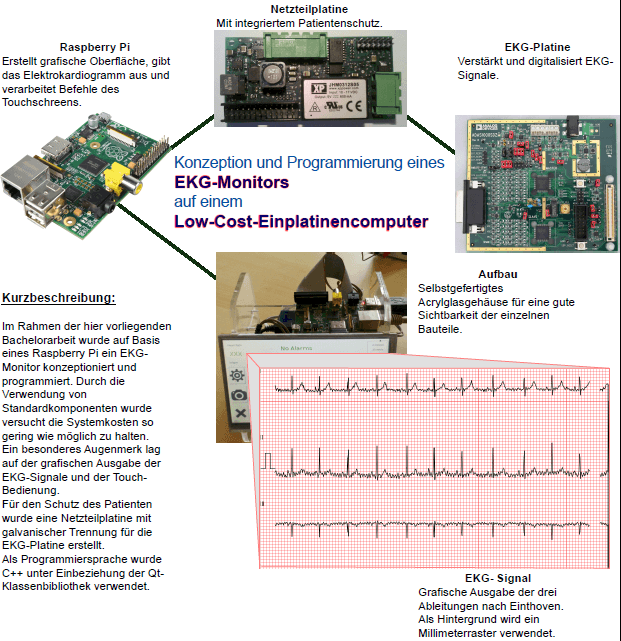
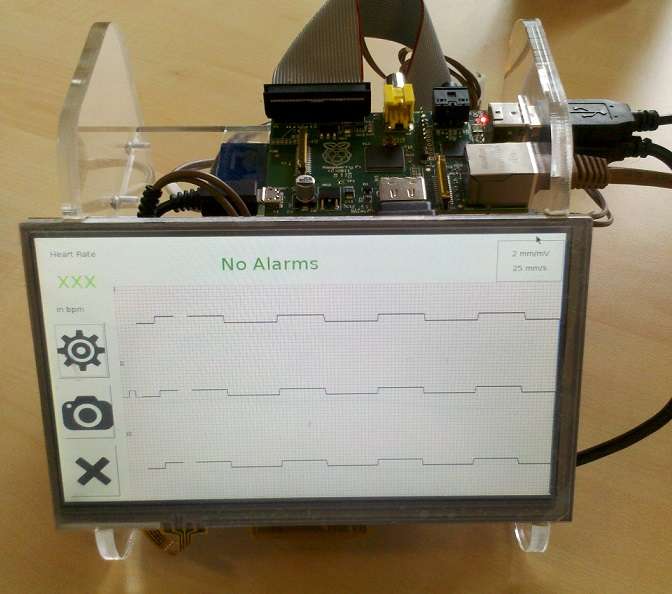
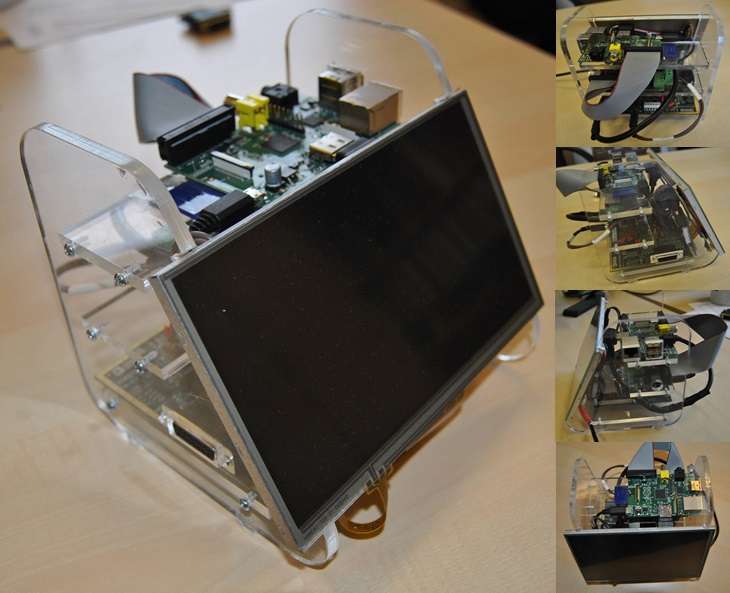
The result is a very nice project and a real eye-catcher. Of course, the device isn't the basis for a product. As a prototype, the system is very well suited for quickly running and testing software on a demonstrator. The software was written in C++, and Qt was used for the graphical interface.
Benjamin Eichinger received a 1.0 for this work. And I'm delighted that he's also completing his master's thesis with us.
Best regards
Goran Madzar